
'Make in India' could suffer the same fate as did privatisation and the command economy, says Ajit Balakrishnan.

BJP President Amit Shah -- arguably the second most powerful politician in the nation -- granted a rare television interview to the Network 18 group of news channels. Rediff.com's Rajesh Alva checks out what the BJP boss said in this word cloud assessment of the interview.

Several states that imposed prohibition in the past lifted it once revenue loss began to pinch

One of the urgent tasks ahead for the new government should be to improve public trust in the executive.

Following is the full text of Congress vice-president Rahul Gandhi's speech at FICCI's 86th annual general meeting on Saturday:

Pranjul Bhandari, Chief India Economist, HSBC, speaks about a range of issues ranging from inflation, to how Goods and Services Tax and land acquisition bills can help India hit double digit growth, and her impressions about economic growth in the last one year after Narendra Modi took over as India's Prime Minister.

The blockchain, the public ledger that tracks every bitcoin transaction, is changing commerce as we know it, says Devangshu Datta.

Xi Jinping has accumulated great power, but he faces trials that are just as great, says Claude Smadja.

Sahil Kapoor of Edelweiss Retail Capital Market Research says that setting up a monetary policy committee should have been the first step. And the central bank could have moved towards a formal inflation targeting mechanism after the processes and data sets are in place.
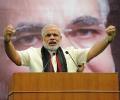

'India is no longer the India of the '70s and the '80s.' 'It's a large country with the fastest growing economy.' 'In working with India, you just can't go and humiliate the nation publicly.' USIBC President Mukesh Aghi tells Aziz Haniffa/Rediff.com about how he advises American companies to do business with India, what he thinks of Modi's government and the way forward for the India-US relationship.
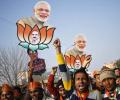
'The prime ministership needs a statesman, not a politician, and 18 months into the job Modi is yet to learn the difference between the two,' says Saisuresh Sivaswamy.

We suffered worse political degradation during the Emergency. But we emerged resurgent and vigorous because the spirit was not broken. This time around, we face an imminent threat to it, says Shreekant Sambrani
.jpg)
We present Prime Minister Manmohan Singh's full speech as he addressed the country on the occasion of 66th Independence Day, from Red Fort, Delhi.

Sri Srinivasan, the first Indian-origin federal judge in the United States, is India Abroad Person of the Year 2013

'The darkest days of Indian democracy were (during) the Emergency when basic democratic rights were suspended. For a time it seemed as though India would move along the East Asian model -- everybody works hard, nobody asks questions, certainly not of the government.' 'There are people who say we are headed that way, but I am not persuaded by the evidence,' says Mahesh Rangarajan who recently resigned as director of the Nehru Memorial Museum and Library in New Delhi.

'I would like to request the AERB, UCIL and DAE to introspect. The world is changing, so is India. The wave of development and modernity will not stop for those who continue to live in the past. The future belongs to the youth who believe in the values of honesty, transparency and efficiency.'

President Pranab Mukherjee on Monday addressed the first joint sitting of Parliament as mandatorily required under the Constitution after the general elections. The address is the political, economic and foreign policy road map of the Narendra Modi government and covers virtually all crucial areas.

Biometric authentication is based on the unscientific and questionable assumption that there are parts of human body that does not age, wither and decay with the passage of time.
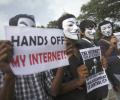
'Although I am from a different party, I would support this government if they draft an unambiguous section to replace 66A. That is the need of the hour, not from the government's point of view, but from the netizens's point of view,' says former IT minister Milind Deora, in this column exclusive to Rediff.com

The fragmentation of politics and the pressures of coalition management have contributed to a near-secular rise in budgetary social expenditures and spending on subsidies since 1991, leaving little fiscal space for government-led capital investment.

The following is the full text of US President Donald Trump's first address to a joint session of the Congress on February 28, as prepared for delivery and released by the White House press office.

Imagine being a part of a country, but being discriminated against by the majority community and atrocities being committed against you by the state. This is the deplorable conditions that the Rohingyas of Myanmar live in where they are cut off from their livelihoods and sources of income, unable to access markets, hospitals and schools, and have little or no access to relief aid. In order to understand the situation and the genesis of the tragedy unfolding, Rediff.com's Archana Masih speaks to Ambassador Vijay Nambiar, the United Nations' Chef de Cabinet (Chief of Staff), who had served a long stint with the UN in New York on the issue.
.jpg)
The toxic brew of fiscal populism, crony capitalism and bad economic management has ensured the collapse of economic growth, industrial stagnation, stubbornly high consumer inflation, declining savings and investment, shrinking employment opportunities, and a dangerously vulnerable external financing situation.

The Big Chill is an upmarket cafe in New Delhi's tony Khan Market and that's where Deora wanted to meet. He introduces me to his favourite cake: tiramisu with a generous infusion of Bailey's, the Irish creme liquor. I take a spoonful, recall the reading on the bathroom scales earlier that morning, and resolutely push it aside, writes Aditi Phadnis.

President Pranab Mukherjee on Thursday addressed the nation on the eve of the 68th Independence Day.
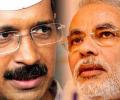
'The AAP is likely to take root in some metropolises -- although it won't be easy to replicate the small-scale Delhi model with equal intensity or cadre-strength in a large state,' says Praful Bidwai.
Attorney General Mukul Rohatgi's stand that AMU is not a minority university reveals the anti-minority stand of the political party now in power, says Mohammad Sajjad, outlining the long history behind one of India's premier universities.

Outlining seven principles of engagement for closer cooperation between India and China, Prime Minister Manmohan Singh on Thursday said the two countries should show sensitivity to each other's interests and sovereignty and move quickly to resolve the boundary issue.

India and China on Wednesday signed in all nine agreements, including the Border Defence Cooperation Agreement and one on strengthening cooperation on trans-border rivers, after restricted and delegation-level talks that lasted over two hours as Prime Minister Manmohan Singh and Premier Li Keqiang met for the second time this year for talks which the Indian leader described as "fruitful and productive".
In an interview to Rediff.com's Anita Katyal, Shambhu Srivastava speaks about the need of breaking out of the communal-secular paradigm and focusing on the Congress party's poor performance and its track record in fuelling communalism.

Indian economy about to take-off

It is rare for communal riots to spread to rural areas. The UP riot is the first time after the September 1969 Gujarat riots that a rural area have been affected. Electoral politics which divide society in majority/minority, going on since the early 1990s, is a major contributing factor to this heightened tension between communities, says Colonel (retd) Anil Athale in the first of a two part series.

Maharashtra Finance Minister Sudhir Mungantiwar speaks to Prasanna Zore/Rediff.com.
Based on the GDP numbers and the remarkable stability of the taka Bangladesh's Prime Minister, Sheikh Hasina, is a better manager than our 'economist prime minister',' says TVR Shenoy.

'Modi as the PM of the country has to take everybody on board and deliver on good governance. That is his responsibility. In that talking alone won't help, he's working.' Commerce Minister Dr Nirmala Sitharaman tells Sheela Bhatt/Rediff.com how the Modi government plans to change India.

'I am almost tempted to say there is some kind of a vested interest operating to play down the achievements of Modi.' 'I think the focus should be on what has been achieved in 70 days and not on how this government functions.' Commerce Minister Nirmala Sitharaman's exclusive interview with Sheela Bhatt/Rediff.com on how the Modi sarkar is changing India.

The new ordinance on land acquisition will allow land grabbers to deprive millions, destroy agriculture, horticulture, rivers, forests, tree cover and mangroves to extract minerals as well as ground water, without replenishment at a pace that will not leave anything for the next generation, warns activist Medha Patkar.

Isn't National Intelligence Grid and UIDAI engineered by vested interests, asks Gopal Krishna.

The year 2014 has been an eventful one for India. The country got a new government and a new state, broke new frontiers in various fields and of course its share of controversies.
